An Ottawa field test exposes the privacy gap created when cameras move from hands to faces.
During an observation lasting under three hours at TD Place Arena, an iPhone running passive Bluetooth Low Energy scanning detected 15 signals consistent with camera-equipped smart glasses among a crowd of roughly 7,000 people.
The frames would have looked ordinary to almost everyone around them. The people in the room had no independent notice that recording-capable glasses were likely present.
Two kilometres away, the same phone observed 823 Bluetooth devices at Meridian Theatres and returned zero smart-glasses matches. That contrast captures the current state of the technology: camera glasses remain relatively uncommon in Canadian public spaces, while their presence is remarkably difficult for bystanders to verify.
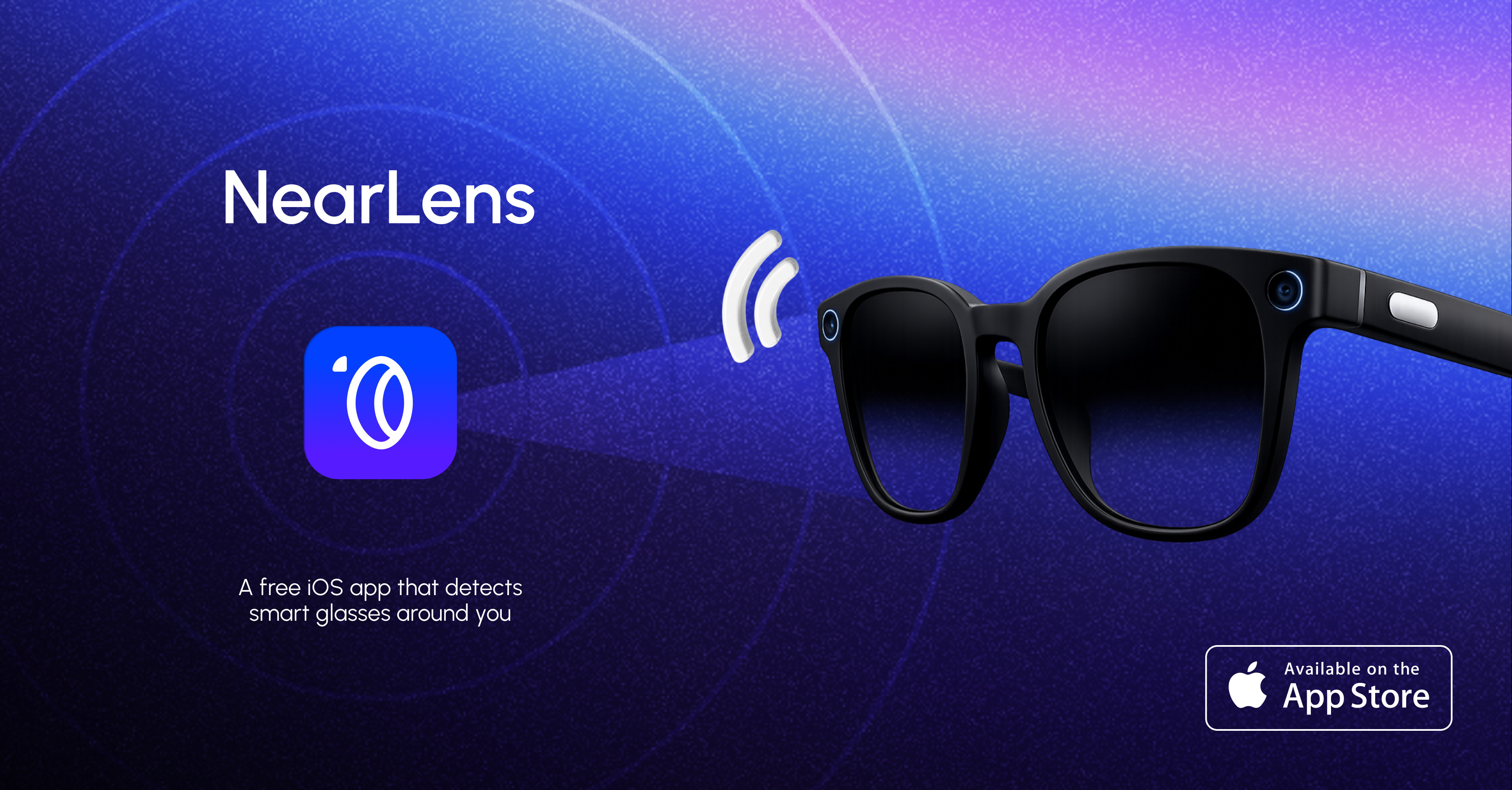
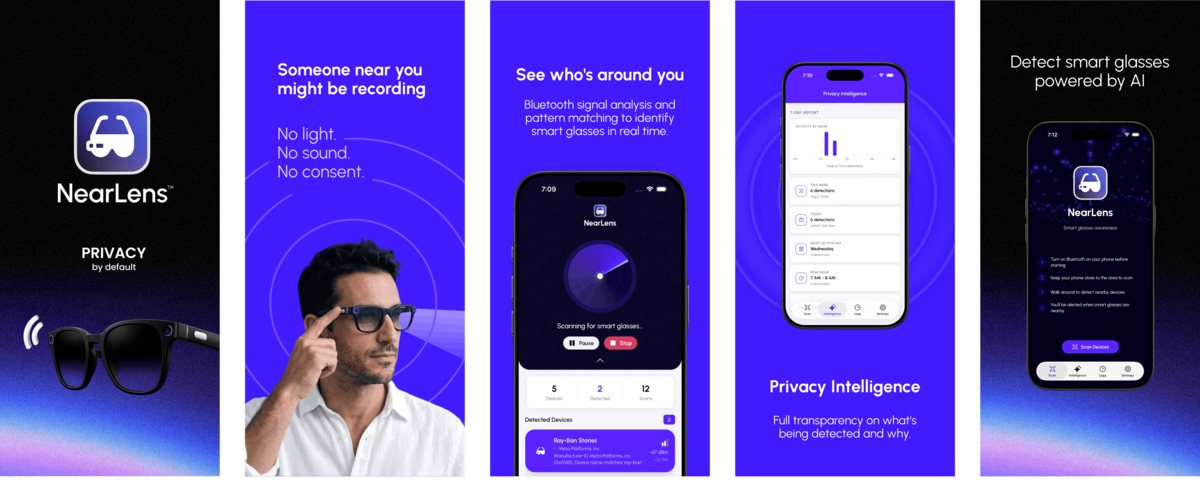
NearLens grew from that visibility gap. Built in Ottawa, the free iOS app listens for Bluetooth evidence associated with camera-equipped eyewear and processes every match on the iPhone. It does not access a camera or microphone. It cannot identify a wearer or confirm that recording is active. Its role is narrower: give people around the device a calm signal that previously belonged only to the wearer.
How smart glasses changed the terms
The camera became harder to read
A phone makes photography socially legible. Someone raises a screen, points a lens and adopts a familiar posture. People nearby may object, step away or change what they are doing.
Smart glasses compress that visible action into a tap, a voice command or automated sensing. The camera sits inside a familiar object and faces whatever the wearer faces. A small capture light may be the only external cue.
European regulators identified this issue at the category's beginning. In 2021, the Irish Data Protection Commission and Italy's Garante questioned whether the small LED on Ray-Ban Stories gave bystanders effective notice. In 2023, 404 Media documented a US$60 physical modification that disabled the light while leaving recording functional. Meta later introduced stronger anti-tamper protections.
The larger shift extends beyond saved photos and videos. AI glasses can analyse scenes, process speech and connect what they perceive to cloud services, public databases or real-time assistance. Harvard students demonstrated that reach through I-XRAY, a project combining Ray-Ban Meta glasses, face-search engines, language models and public records to surface names, addresses and phone numbers simply by looking at someone.
The technology has valuable uses in accessibility, live translation, navigation and hands-free communication. Those benefits depend on sensing a shared environment. The wearer receives the service. Everyone in view becomes part of its input.
What independent research found
Research shows an expectation gap
A 2026 CHI study involving 525 survey participants and 20 paired interviews found a persistent gap between the privacy protections bystanders expected and what wearers were willing to provide. In sensitive settings, 65% to 90% of bystanders said they would take defensive action. Researchers also found that small recording indicators can be difficult to see, easy to obstruct and socially ambiguous.
Emerging research from the University of Sydney examined 350 public Instagram videos recorded with smart glasses between 2023 and 2026. Within a subset of covert point-of-view videos, roughly 60% of interactions were classified as potential harassment. In about 43% of the analysed videos, women were exposed to abusive comments, sometimes including personal information. The researchers describe this model as ambient capture: discreet recording in ordinary spaces, followed by rapid distribution online.
Public institutions have started responding. Restaurants, theatres and pub chains in the United Kingdom have restricted camera-equipped glasses. Courts in New York introduced a ban in July 2026. On August 11, courts across England and Wales announced that smart glasses would be confiscated at entry and returned when the owner left. These measures protect specific environments. Most shared spaces still depend on a bystander recognising a device that was designed to resemble ordinary eyewear.
The finding that shaped the product
Seven wearers described the same asymmetry
Before development began, seven owners of smart glasses were interviewed across Waterloo, Atlanta, San Francisco, Indianapolis, Ottawa and Toronto. Across the research, the same difference between a phone and glasses kept resurfacing.
I'm recording without them knowing it.
With a phone, they know.
None of the seven had read the terms and conditions in full. One had skimmed them and retained only a reference to anonymous model training. Others described having no habit of reading policies, fearing what they might discover or seeing comprehensive review as incompatible with everyday digital life.
Reactions to being detectable were mixed. Three participants judged detection fair, two objected and two remained conditional. Acceptance was the most frequent response, although none of the accepting participants grounded that response in a bystander's right to know. Their reasoning centred on device symmetry: the wearer has a device, and the bystander can have one too. One participant said she would turn off Bluetooth if she knew an app could detect the glasses.
That answer shaped the product. NearLens reports likely device presence, never proof of recording. Detection is passive and one-way. The app includes no map, account, public directory or reporting system. It offers no route to identify a wearer.
One participant, a former Meta staff member, said modified firmware could disable the recording indicator. Another participant knew someone who used a physical cover. A third tried black tape and found that the glasses stopped working, showing an interlock in at least one device generation. The working record supports a narrower conclusion: the indicator is beatable through some routes and technically protected through others. The firmware statement awaits independent testing.
The camera was only part of the research. One participant identified the microphone as the forgotten vector and wanted a physical switch dedicated to it. Across all seven owners, no bystander had ever directly asked them to stop using the glasses. Discomfort appeared through looks, questions or distance. The research cannot determine whether that reflects social acceptance or the personal cost of confronting someone.
What bystanders are already searching for
The language points to an unmet public need
Search language has already converged on the gap. People type smart glasses detector, camera glasses detector, smart glasses privacy alert or detect smart glasses nearby when they are looking for the same thing: smart glasses awareness for people around the device.
NearLens describes the category more precisely as a bystander privacy app. It listens for Bluetooth evidence associated with nearby smart glasses and turns that evidence into an independent privacy signal. The signal covers recording-capable glasses; camera activity remains unknown.
That distinction matters. A Bluetooth match says that a compatible device is likely nearby. It says nothing about who owns it, what they are doing or whether an image is being captured.
What the field testing actually showed
Rare in the sample, invisible in the room
Six observations took place across four cities. At the two sites where total device counts were logged, the scans recorded 1,564 visible Bluetooth devices. Smart-glasses matches were uncommon.
| Location | Result |
|---|---|
| TD Place Arena (Ottawa, Canada) | 1511 by company ID · 4 by device name |
| Meridian Theatres (Ottawa, Canada) | 0823 devices scanned |
| YOW (Ottawa, Canada) | 1total not logged |
| YYZ (Toronto, Canada) | 0total not logged |
| SFO (San Francisco, USA) | 0total not logged |
| DCA (Washington, USA) | 1741 devices · VR headset (Quest 3) |
The DCA result illustrates a known limitation. Bluetooth manufacturer identifiers can also appear on related products, including VR headsets. Signal strength changes with walls, bodies, radio interference and the way a device is worn. Distance is therefore approximate. Glasses that stop broadcasting, switch Bluetooth off or use an unknown signature may remain undetected.
This field work is a small observational sample. It does not estimate prevalence across Canada, the United States or any individual venue. It shows something more immediate: likely smart-glasses signals can be separated from a dense Bluetooth environment while the surrounding public remains unable to recognise the devices by sight.
Scope of the research
What the evidence can support
The interview corpus is qualitative: seven owners, all in North America, within a narrow manufacturer ecosystem dominated by Meta and EssilorLuxottica. Three interviews are documented from full transcripts. Four remain documented through earlier working syntheses awaiting a fresh check against the original audio. The reactions to detection were hypothetical, and the study included no non-users, European participants, journalists or activists.
Six repeating themes provide a useful design signal within this group. They do not support population percentages or claims about every smart-glasses owner. The field observations establish technical feasibility in specific places and moments, not market prevalence.
Privacy as architecture rather than promise
No backend. Nothing leaves the phone.
NearLens has no backend. Detection, matching, history and supported AI queries remain on the iPhone.
- Bluetooth Low Energy scanning runs locally against known manufacturer identifiers and on-device signal patterns
- No account, email address, advertising identifier, analytics service, ad network or telemetry is present
- Detection log lives in local storage for up to 90 days, exportable via the iOS share sheet
- One action clears the full history
- On compatible devices, Privacy Intelligence and Ask NearLens use Apple's on-device Foundation Models on iOS 26
- Older devices use a local statistical fallback - no cloud fallback is used
- iOS requests location permission as part of BLE access; NearLens does not use or store the phone's position
- VoiceOver labels, dynamic accessibility announcements, reduced-motion support and haptic feedback are integrated under WCAG 2.2 AA targets
The App Store privacy label states that no data is collected. That claim is visible before installation.
A warning built into the product
Awareness without counter-surveillance
A privacy tool can reproduce the same imbalance it is trying to address. A proximity alert might encourage confrontation, public accusation or harassment of a legitimate wearer, including someone using smart glasses for vision or hearing support.
NearLens opens with an inline warning that harassing someone over a suspected recording device may itself be a criminal offence, potentially more serious than the recording under local law. The warning interrupts the app's visual language and cannot disappear automatically.
Alerts are deliberately calm. A quiet haptic precedes the visual message, and the interface uses rose instead of an alarm-red treatment. The app records a possible device encounter, never a person. There is no owner profile, crowd-sourced map, evidence feed or mechanism for public accusation.
The design gives bystanders information while avoiding a new tracking system.
Why this matters
The public deserves a signal too
Smart glasses place control, settings, deletion and sharing in the wearer's hands. The people across the table, beside the wearer at a concert or standing nearby in an airport receive none of those controls.
"Smart glasses moved a privacy decision onto people who never bought them. NearLens gives bystanders a calm, independent signal without identifying, tracking or reporting the person wearing the device. Awareness should belong to everyone in the room."
Marcos Rezende, designer of NearLensThe TD Place observation makes no accusation against the people associated with the 15 likely matches. It documents a visibility gap affecting thousands of others in the same space.
NearLens treats one symptom of that gap. It demonstrates that passive detection can be technically feasible, local-only and free. The structural issue remains larger: platform consent flows reach the wearer while the people in frame remain outside the design contract.
NearLens was built to make that boundary visible.
About
About NearLens
NearLens is a free iOS bystander-awareness tool developed in Ottawa, Canada. It uses on-device Bluetooth Low Energy analysis to identify signals associated with camera-equipped smart glasses while collecting no personal data. NearLens is available on the App Store and at nearlens.app.
Research and reporting referenced
Sources
- Mind the Gap: Mapping Wearer-Bystander Privacy Tensions and Context-Adaptive Pathways for Camera Glasses, CHI 2026
- Experts issue urgent warning about high-risk smart glasses, Mediaweek and University of Sydney researchers
- I-XRAY: the AI glasses that reveal anyone's personal details, Harvard Library Innovation Lab
- Data Protection Commission statement concerning Facebook View glasses
- A $60 Mod to Meta's Ray-Bans Disables Its Privacy-Protecting Recording Light, 404 Media
- Meta glasses banned from courts in England and Wales, The Guardian
Share
If this story matters to you, pass it on.